
Understanding beauty-tech treatments
A clear, educational and non-medical guide to the main technologies used in at-home skincare devices.


Sculpt and tone

Support facial tone, defined contours and a visibly firmer appearance.
01Microcurrent
Microcurrent is a technology that uses a very low-intensity electrical current. It is mainly used in facial toning devices.
Its aim is to support gentle stimulation of the facial muscles. In beauty devices, microcurrent is often associated with visible toning, firming, contouring and lifting effects.
It is neither a medical procedure nor a surgical facelift. It is a cosmetic technology used as part of a regular routine to help the face look more toned, rested and defined.
Application
Facial skin is supported by a muscular structure. Over time, facial features may look less firm or defined. Microcurrent delivers very weak electrical pulses designed to support stimulation of these areas.
The intended effect is mainly visual: clearer contours, an impression of firmness and a face that looks more toned.
Areas
Microcurrent is often used on:
- the facial contours
- the jawline
- the cheeks
- the cheekbones
- the forehead
- the neck
Summary
Microcurrent is a very gentle form of electrical stimulation used to support facial tone and improve the appearance of the contours.
02EMS — Electrical Muscle Stimulation
EMS stands for Electrical Muscle Stimulation. This technology uses electrical pulses designed to trigger or support muscle activation.
In facial beauty devices, EMS is generally used to promote a feeling of tone and firmness. It is often described as a form of “assisted facial exercise”.
EMS is more noticeable than microcurrent. Depending on the device and intensity, the user may feel slight muscle contractions, tingling or vibrations.
Application
Facial muscles contribute to expression, the support of facial features and the face's overall appearance. EMS delivers controlled electrical pulses to support the activation of certain muscle areas.
The aim is to help certain areas look firmer, more toned and less slack with regular use as part of a cosmetic routine, rather than to transform the structure of the face.
Areas
EMS is often used on:
- the cheeks
- the facial contours
- the jawline
- the neck
- certain areas of the forehead, depending on the device
How it differs from microcurrent
Microcurrent is generally gentler and more subtle. EMS is often more noticeable and more closely associated with direct muscle activation.
The two technologies can complement each other, but they do not produce exactly the same sensation or user experience.
Summary
EMS uses controlled electrical pulses to support muscle activation and give the face a more toned appearance.
03Mechanical massage / roller / beauty-tech gua sha
Mechanical massage covers tools that work through physical movement: rollers, rotating heads, massage attachments or shapes inspired by gua sha.
These devices do not necessarily rely on complex electrical technology. Their main action comes from movement, pressure and the massage technique.
Application
Mechanical massage helps stimulate the skin's surface, relax facial features and support cosmetic drainage techniques. It can be used alone or with a skincare product applied to the skin.
In a beauty routine, this type of tool is mainly associated with a feeling of relaxation, a fresher-looking face and a more structured ritual.
Areas
Mechanical massage is often used on:
- the cheeks
- the jawline
- the neck
- the forehead
- the contours of the face
Summary
Mechanical massage uses movement and pressure to relax facial features, support cosmetic drainage and structure the facial ritual.
Firm and smooth

Support the appearance of firmness, smoother texture and skin quality.
04RF — Radiofrequency
Radiofrequency, often abbreviated to RF, is a technology that uses electromagnetic waves to generate controlled heat in the skin's tissues.
In beauty-tech devices, it is mainly used to support skin-firming routines. Radiofrequency is often associated with improvements in the appearance of skin firmness, elasticity and texture.
It is widely used in anti-ageing devices, particularly for the face, neck and certain areas of the body.
Application
Radiofrequency works by generating heat. This heat is controlled and distributed through the skin's layers. In cosmetic use, the aim is to stimulate the skin through a gentle thermal effect.
The intended sensation is generally a gradual, comfortable and controlled warmth. With regular use, radiofrequency is associated with skin that looks firmer, smoother and denser.
Areas
RF is often used on:
- the cheeks
- the facial contours
- the chin
- the neck
- the forehead
- areas of the body prone to skin laxity
Important point
Radiofrequency should be used with care, following the manufacturer's instructions. The warmth should remain controlled and comfortable. An excessive burning sensation or discomfort is not normal.
Summary
Radiofrequency uses controlled heat to support firming routines and improve the appearance of skin firmness.
05Red LED — Red Light Therapy
Red LED light is a technology used in many beauty-tech devices, including LED masks and facial skincare devices.
It uses visible red light, often associated with routines designed to improve radiance, texture and the appearance of visible signs of ageing.
Red LED light is valued because it is non-invasive, painless and easy to incorporate into a regular routine.
Application
The skin responds to certain wavelengths of light. Red LEDs emit a specific light used in cosmetic skincare to support the skin's appearance.
It is often associated with more radiant skin, more even texture and a smoother appearance. It does not replace dermatological treatment, but it can form part of a regular beauty routine.
Areas
Red LED light is often used on:
- the whole face
- the neck
- the décolletage
- sometimes certain areas of the body, depending on the device
Summary
Red LED light uses visible light to support radiance, texture and a smoother-looking complexion.
06NIR — Near infrared
NIR stands for near infrared. It is light that lies beyond visible red light and is therefore generally invisible to the human eye.
In beauty-tech devices, NIR is often used alongside red LED light. It is associated with light acting deeper than visible red light.
NIR is generally used in routines for anti-ageing, firmness and skin quality.
Application
Red LED light acts mainly at the surface or in the skin's more superficial layers. Near infrared is used to complement this action with light that penetrates deeper.
In a cosmetic context, the aim is to support the appearance of firmness, density and overall skin quality.
Areas
NIR is often used on:
- the face
- the neck
- the décolletage
- certain areas of the body, depending on the device
How it differs from red LED light
Red LED light is visible. NIR is generally invisible or barely visible.
Red LED light is often associated with radiance and texture. NIR is more closely associated with deeper action on the appearance of firmness.
Summary
Near infrared complements red LED light by supporting the appearance of firmness and skin quality at greater depth.
07Ultrasound
Ultrasound uses very high-frequency vibrations. In beauty devices, it is often used for cleansing, gentle exfoliation or to support the application of skincare products.
It is found in ultrasonic skin spatulas and some multifunction devices.
Application
Ultrasound produces very rapid vibrations. These vibrations can help lift impurities from the skin's surface, smooth the appearance of skin texture or support the application of a skincare product.
In cosmetic use, ultrasound is mainly associated with skin that looks clearer, cleaner and better prepared.
Areas
Ultrasound is often used on:
- the nose
- the chin
- the forehead
- areas prone to visible pores
- the whole face, depending on the device
Summary
Ultrasound uses high-frequency vibrations to support cleansing, gentle exfoliation and skin preparation.
Cleanse and prepare

Cleanse the skin, prepare it for skincare and structure the ritual.
08Silicone cleansing / cleansing pulsations
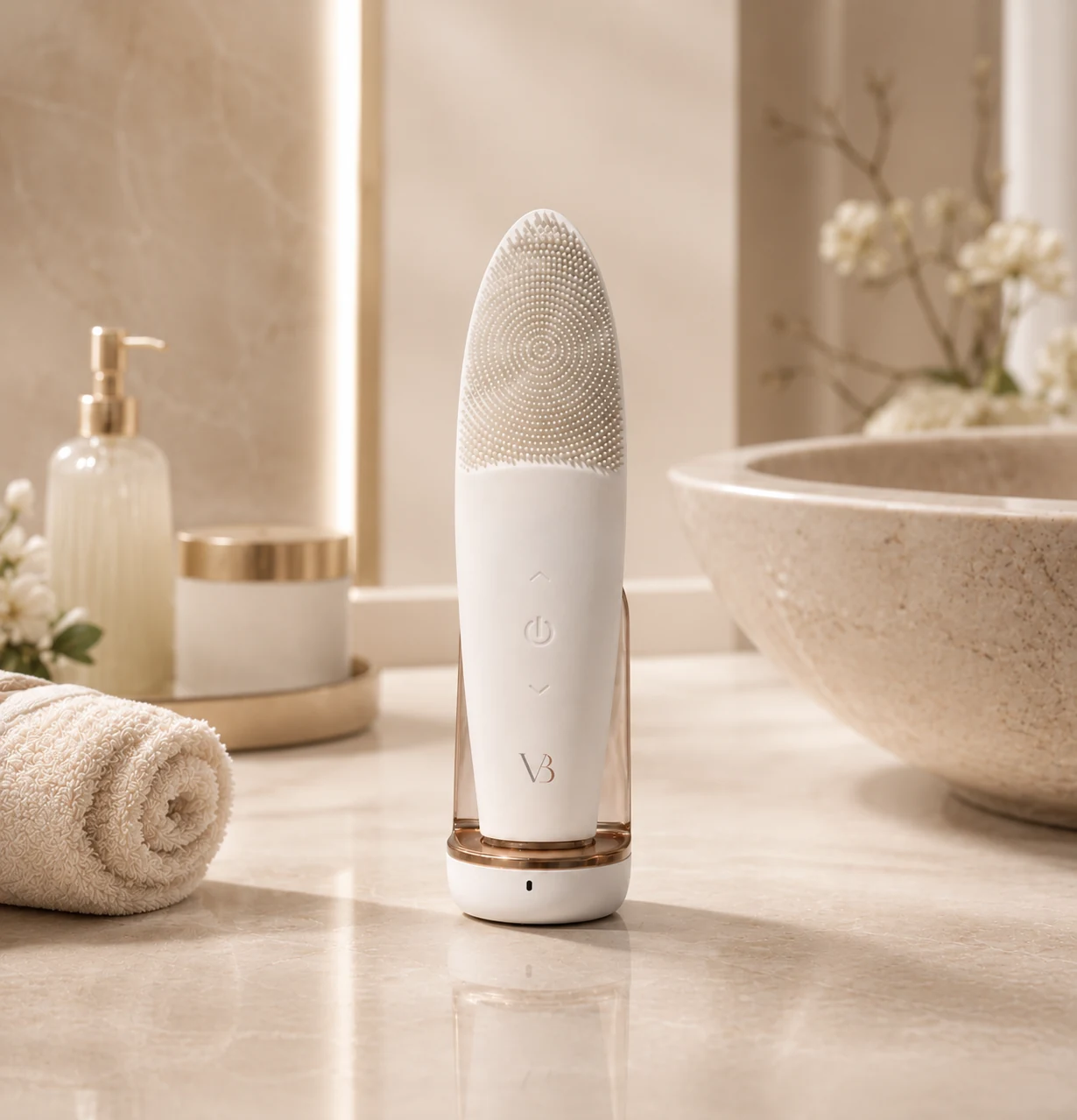
Silicone cleansing devices generally combine soft bristles with vibrations. They are used to cleanse the skin more consistently than conventional manual cleansing.
This technology is often used in facial cleansing brushes.
Application
The silicone bristles come into contact with the skin, while vibrations help loosen impurities, sebum and make-up residue. Silicone is valued because it is gentle, hygienic and easy to clean.
In cosmetic use, the aim is cleaner, fresher skin that is better prepared for the skincare steps that follow.
Areas
Silicone cleansing is often used on:
- the forehead
- the nose
- the cheeks
- the chin
- the whole face
Summary
Silicone cleansing combines soft bristles and vibrations to gently cleanse the skin and prepare it for skincare.
09Sonic vibration
Sonic vibration uses rapid micro-pulsations. It is widely used in cleansing brushes, facial massage devices and some multifunction devices.
It can be used to cleanse, massage, help distribute a skincare product or make the ritual more enjoyable.
This technology is valued because it is easy to understand and produces an immediate sensation during use.
Application
Rapid vibrations create a regular movement at the skin's surface. This movement can help loosen impurities during cleansing, gently massage the face or distribute a product applied to the skin more evenly.
In a beauty device, sonic vibration therefore contributes both to the effectiveness of the technique and to comfort during use.
Areas
Sonic vibration is often used on:
- the whole face
- the cheeks
- the forehead
- the chin
- the neck, depending on the device
Summary
Sonic vibration uses rapid micro-pulsations to support cleansing, massage and the application of skincare products.
10Galvanic current
Galvanic current is a low-intensity direct electrical current. It is used in some facial skincare devices to support cleansing, skin preparation or the application of skincare products.
Depending on the mode used, it may be described as an aid to ionic cleansing or the distribution of cosmetic products.
It is a technology often found in multifunction devices.
Application
Galvanic current is based on the principle of electrical polarity. Some devices use one polarity to help attract or remove certain impurities from the skin's surface. Other modes are used to support the application of skincare products.
The aim is to prepare the skin and create a more structured ritual: cleanse, prepare, apply, then optimise.
Areas
Galvanic current is often used on:
- the face
- the nose
- the chin
- the cheeks
- areas where skincare products are applied
Summary
Galvanic current supports certain cleansing, preparation and skincare application steps through gentle electrical polarity.
11Positive and negative ionisation
Some skincare devices use ionic modes, often described as positive ion and negative ion. These modes are based on the principle of electrical polarity.
They are generally used to support skin cleansing or the application of skincare products.
Application
Positive ion mode is often described as a cleansing aid because it supports the removal of certain impurities from the skin's surface.
Negative ion mode is often described as an aid to skincare application because it supports the distribution of cosmetic products applied to the skin.
The exact terms may vary between manufacturers, but the general idea is the same: use gentle electrical polarity to structure the ritual.
Areas
Ionisation is often used on:
- the face
- the nose
- the chin
- the cheeks
- areas where a skincare product is applied
Summary
Ionisation uses gentle electrical polarities to support skin cleansing or the application of cosmetic skincare products.
Optimise skincare application

Support the application of the serums, creams and gels used with the devices.
12Electroporation
Electroporation is a technology that uses controlled electrical pulses. In cosmetic devices, it is often described as an aid to skincare application.
It is generally used with serums, gels or creams to support their distribution across the skin's surface.
Cosmetic electroporation should not be confused with a medical technique. In a beauty routine, it is mainly used to optimise the skincare application experience.
Application
The skin forms a natural barrier. Electroporation uses electrical pulses to temporarily support the application of cosmetic active ingredients.
The aim is a more complete ritual: a skincare product is applied, then the device helps distribute it and support its diffusion through the skin.
Areas
Electroporation is often used on:
- the face
- the neck
- areas where a serum or cream is applied
- sometimes the eye contour, depending on the device and its recommendations
Summary
Electroporation uses controlled pulses to support the application and diffusion of cosmetic skincare products.
13Galvanic current
Galvanic current is a low-intensity direct electrical current. It is used in some facial skincare devices to support cleansing, skin preparation or the application of skincare products.
Depending on the mode used, it may be described as an aid to ionic cleansing or the distribution of cosmetic products.
It is a technology often found in multifunction devices.
Application
Galvanic current is based on the principle of electrical polarity. Some devices use one polarity to help attract or remove certain impurities from the skin's surface. Other modes are used to support the application of skincare products.
The aim is to prepare the skin and create a more structured ritual: cleanse, prepare, apply, then optimise.
Areas
Galvanic current is often used on:
- the face
- the nose
- the chin
- the cheeks
- areas where skincare products are applied
Summary
Galvanic current supports certain cleansing, preparation and skincare application steps through gentle electrical polarity.
14Positive and negative ionisation
Some skincare devices use ionic modes, often described as positive ion and negative ion. These modes are based on the principle of electrical polarity.
They are generally used to support skin cleansing or the application of skincare products.
Application
Positive ion mode is often described as a cleansing aid because it supports the removal of certain impurities from the skin's surface.
Negative ion mode is often described as an aid to skincare application because it supports the distribution of cosmetic products applied to the skin.
The exact terms may vary between manufacturers, but the general idea is the same: use gentle electrical polarity to structure the ritual.
Areas
Ionisation is often used on:
- the face
- the nose
- the chin
- the cheeks
- areas where a skincare product is applied
Summary
Ionisation uses gentle electrical polarities to support skin cleansing or the application of cosmetic skincare products.
15Sonic vibration
Sonic vibration uses rapid micro-pulsations. It is widely used in cleansing brushes, facial massage devices and some multifunction devices.
It can be used to cleanse, massage, help distribute a skincare product or make the ritual more enjoyable.
This technology is valued because it is easy to understand and produces an immediate sensation during use.
Application
Rapid vibrations create a regular movement at the skin's surface. This movement can help loosen impurities during cleansing, gently massage the face or distribute a product applied to the skin more evenly.
In a beauty device, sonic vibration therefore contributes both to the effectiveness of the technique and to comfort during use.
Areas
Sonic vibration is often used on:
- the whole face
- the cheeks
- the forehead
- the chin
- the neck, depending on the device
Summary
Sonic vibration uses rapid micro-pulsations to support cleansing, massage and the application of skincare products.
Soothe, refresh and finish

Bring comfort, relax facial features, refresh the skin and complete the ritual.
16Thermotherapy — gentle warmth
Thermotherapy means using warmth in a skincare routine. In beauty-tech devices, it is often used to bring comfort, relax facial features and support the application of skincare products.
It is found in some facial and eye contour devices, masks and multifunction tools.
Application
Gentle warmth creates a feeling of relaxation. It can help make skincare application more pleasant and turn a quick step into a more comfortable ritual.
In cosmetic use, warmth is mainly used for its sensory effect: comfort, relaxation and a feeling of relaxed skin.
Areas
Thermotherapy is often used on:
- the face
- the eye contour
- the neck
- certain areas of the body, depending on the device
Important point
The warmth should always remain comfortable. It should not burn or cause discomfort. Use must follow the manufacturer's recommendations.
Summary
Thermotherapy uses gentle warmth to relax facial features, improve comfort during the ritual and support skincare application.
17Cryotherapy — controlled cooling
Cryotherapy means using cold in a skincare routine. In beauty devices, cooling is often used to refresh the skin, visibly reduce the appearance of puffiness and provide an immediate feeling of freshness.
It is particularly common in eye contour tools, cooling rollers and some hot/cold devices.
Application
Cooling creates a fresh sensation and can help give the face a more rested appearance. It is often used in the morning on areas that look puffy or tired.
In cosmetic use, cooling is mainly associated with an immediate visual effect: fresher-looking features, a less tired-looking eye area and a feeling of toned skin.
Areas
Cryotherapy is often used on:
- the eye contour
- under-eye puffiness
- the cheeks
- the facial contours
- the neck, depending on the device
Summary
Cryotherapy uses controlled cooling to refresh the skin, visibly reduce signs of tiredness in the features and provide a feeling of freshness.
18Alternating warmth and cooling
Some devices combine warmth and cooling in the same ritual. This alternation creates two different sensory effects: warmth to relax and support skincare application, and cooling to refresh and visibly reduce signs of tiredness in the features.
This technology is often used in eye contour devices, multifunction facial devices and some tools for quick skincare treatments.
Application
Warmth is generally used at the start of a treatment or during skincare application to provide comfort. Cooling is often used at the end to give a feeling of fresher skin and more rested features.
Alternating warmth and cooling therefore structures the ritual into several stages: prepare, apply, then finish.
Areas
Warmth and cooling are often used on:
- the eye contour
- the cheeks
- the facial contours
- the neck
- certain targeted areas of the face
Summary
Alternating warmth and cooling combines relaxation, comfort and freshness for a more complete, sensory ritual.
19Heated vibration for the eye contour
Some devices designed for the eye contour combine gentle vibration and warmth. This combination mainly aims to provide comfort, relaxation and a more rested-looking eye area.
It is often used in eye massagers, eye contour pens and small devices for localised skincare.
Application
Gentle warmth helps relax the area. Vibration supports massage and the distribution of an eye contour skincare product.
The aim is to help the eye area look fresher, more relaxed and less tired, rather than to medically treat dark circles or puffiness.
Areas
This technology is used on:
- the eye contour
- the temples
- sometimes the forehead, depending on the device
Summary
Heated vibration combines gentle warmth and light massage to relax the eye contour and give the eye area a more rested appearance.
Body care and specialist routines

Focus on smooth skin, hair removal and specialist body programmes.
20IPL — Intense Pulsed Light
IPL stands for Intense Pulsed Light. This technology is best known for its use in at-home hair removal devices.
It uses flashes of light designed to target hair. Depending on the device, it may also be associated with certain routines for more even-looking skin, but its main use remains gradual hair removal.
IPL is a more technical and more regulated technology than those used for massage or facial skincare.
Application
The device emits short, intense flashes of light. This light is absorbed by the melanin in the hair, allowing the hair-bearing area to be targeted.
In at-home hair removal, the aim is to gradually reduce visible hair regrowth, provided the device is used regularly and in accordance with the recommendations.
Areas
IPL is often used on:
- the legs
- the arms
- the underarms
- the bikini area, depending on the device
- certain areas of the face, only if the manufacturer permits it
Important point
IPL is not suitable for every skin tone or hair colour. Always follow the manufacturer's instructions and check the contraindications before use.
Summary
IPL uses intense flashes of light to support gradual at-home hair removal routines.
21Multicolour light / cosmetic chromotherapy
Some LED devices offer several light colours: red, blue, green, yellow, purple or white, depending on the model.
In cosmetic devices, these colours are generally used to offer several targeted routines: radiance, clearer skin, a calmer-looking complexion, more even tone or comfort.
Not all colours have the same level of recognition as red or blue LED light. They should therefore be presented with care.
Application
Each colour corresponds to a different wavelength. Manufacturers generally associate each colour with a particular cosmetic goal.
Red LED light is often associated with radiance and visible signs of ageing. Blue LED light is often associated with blemishes. The other colours are more often used to complement a routine.
Areas
Multicolour light is often used on:
- the whole face
- the neck
- certain targeted areas, depending on the device
Summary
Multicolour light offers different light programmes to suit the skin's visible needs.
22Specialist body technologies
Application
Support more targeted routines, particularly for smooth skin, hair removal or specialist programmes.